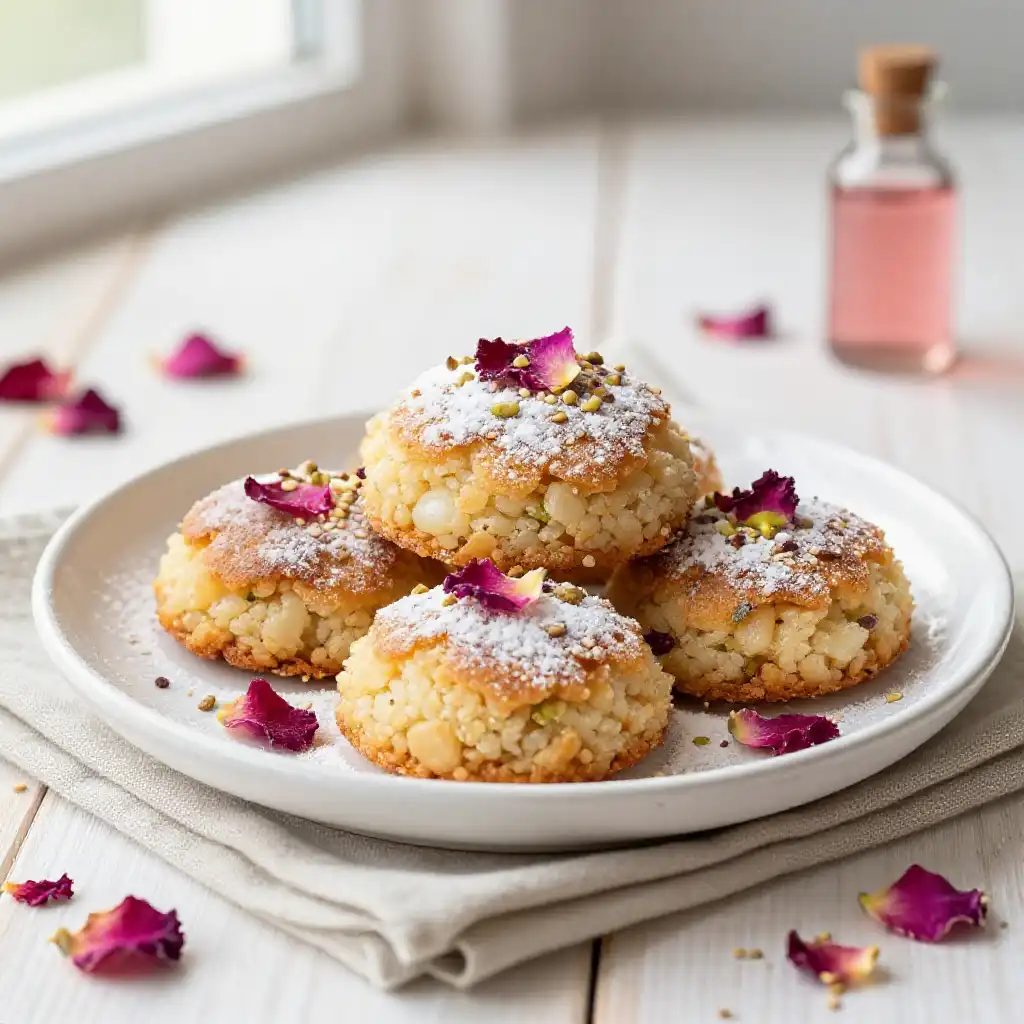
Close your eyes for a second. I want you to imagine the scent of a spring garden after a light rain, but condensed into a single, delicate bite. That’s the magic of a perfect Nan-e Berenji. It’s not a cookie that shouts; it whispers. A whisper of rose petals, a hint of butter, and a melt-in-your-mouth tenderness that feels like culinary silk dissolving on your tongue.
I first fell in love with these elegant little discs at a friend’s Nowruz celebration. Amidst the vibrant spread, this unassuming plate of pale, poppy-speckled cookies called to me. One bite, and I was transported. It was floral, but not perfumey. Sweet, but not cloying. It was, quite simply, edible poetry. And I knew right then I had to learn how to make Persian Nan-e Berenji Rice Cookies with Rose Water in my own kitchen.
Why These Aren’t Your Average Cookie
Let’s be real. The cookie jar is often home to chocolate chips and oatmeal raisin stalwarts. Noble, delicious workhorses. But Nan-e Berenji is the graceful ballet dancer of the cookie world. It’s gluten-free by nature, relying on the fine, powdery magic of rice flour. Its sweetness comes from a syrup, giving it a unique, lingering moisture you just don’t get from granulated sugar alone.
And the rose water? It’s the soul of the operation. It doesn’t taste like soap if you use it right—it tastes like the essence of a thousand petals, lending an aroma that makes every bite feel like a special occasion. This is the treat you serve when you want to impress without effort, to offer a moment of quiet, fragrant delight with a cup of tea. Speaking of which, if you need a brilliant beverage pairing, I’ve got a whole archive of inspiration over on our drinks and smoothies page.
The Secret Life of Rice Flour
Here’s where the science gets fun. The “nan” in Nan-e Berenji means bread, but the texture is anything but bready. The key is rice flour’s lack of gluten. Gluten is the protein that gives structure and chew to wheat-based baked goods. Without it, we have to build structure another way.
That’s where the syrup and the meticulous mixing come in. The syrup binds the fine rice flour particles, and the prolonged creaming of the butter and sugar creates tiny air pockets. When baked low and slow, these pockets set, creating that famously tender, crumbly, meltaway texture. It’s a delicate dance. Use the wrong rice flour (you want fine, not glutinous) or rush the creaming, and the whole fragile architecture can collapse. But get it right? Pure magic.

Your Treasure Map: The Flavor Makers
Gathering these ingredients is half the adventure. You’re not just baking; you’re assembling an aromatic palette.
- Fine Rice Flour (1 ½ cups): This is non-negotiable. Seek out a finely ground brand. The texture should be as soft as powdered sugar.
- Unsalted Butter (½ cup, softened): The rich, creamy foundation. Proper softening is crucial—think cool to the touch but easily indented.
- Granulated Sugar (½ cup): For creaming with the butter to build that essential airy structure.
- Rose Water Syrup: The star player. We’ll make this by dissolving ½ cup of sugar in ¼ cup of water with a tablespoon of lemon juice, then stirring in 2-3 tablespoons of pure rose water after it cools. This is what gives the cookies their signature perfume and moist crumb.
- Poppy Seeds (2 tbsp): For that classic, elegant speckle and a faint, nutty crunch.
- Egg Yolk (1): Our binding agent and source of rich color.
- Cardamom (½ tsp, ground): A warm, citrusy whisper that plays beautifully with the rose.
The Delicate Dance: Let’s Get Crafting
This isn’t a dump-and-stir recipe. It’s a gentle, mindful process. Put on some music, clear your counter, and let’s begin.
Step 1: The Syrup Serenade
In a small saucepan, combine the ½ cup sugar for the syrup with ¼ cup water and a tablespoon of lemon juice. Heat over medium, stirring just until the sugar dissolves. Let it simmer for about 5-7 minutes until it thickens slightly into a light syrup. Remove from heat and let it cool completely. Once cool, stir in 2-3 tablespoons of rose water. This patience is key—adding rose water to hot syrup burns off its beautiful aroma.
Step 2: The Creamy Cloud
In a large bowl, beat the softened butter and the ½ cup of granulated sugar together. Here’s the secret: beat it for a full 5-7 minutes. You want it pale, fluffy, and almost whipped. This incorporates air, which is our replacement for gluten. It’s the most important step for that melt-in-your-mouth texture.
Step 3: The Aromatic Union
Beat in the egg yolk and ground cardamom until just combined. Now, gradually add your cooled rose water syrup, beating continuously. The mixture may look a bit curdled—don’t panic. It will come together.
Step 4: Bringing It All Together
Gradually add the fine rice flour to the wet ingredients, mixing on low speed or by hand with a spatula until a soft, slightly sticky dough forms. It will be softer than typical cookie dough. Fold in the poppy seeds. Cover the bowl and let the dough rest in the refrigerator for at least 30 minutes. This firms it up just enough to handle.
Step 5: Shaping with Care
Preheat your oven to 300°F (150°C). This is a low-and-slow bake. Line baking sheets with parchment paper. Pinch off small pieces of dough (about a heaping teaspoon) and roll into smooth balls. Place them on the sheet and gently flatten with the tines of a fork, creating a classic cross-hatch pattern. They won’t spread much, so you can place them about an inch apart.
Step 6: The Gentle Bake
Bake for 20-25 minutes. They are done when the bottoms are just barely golden and the tops are set but still very pale. Do not let them brown. Overbaking is the enemy of tenderness. Let them cool on the sheet for 5 minutes before transferring to a wire rack to cool completely. They firm up as they cool.
How to Avoid Cookie Catastrophe (A Cautionary Tale)
I’ve had my share of Nan-e Berenji fails, so you don’t have to. Here’s the shortlist of “oh-no” moments:
- The Brick: Over-mixing after adding the flour. You’re incorporating, not kneading. Stop as soon as it comes together.
- The Puddle: Using hot syrup or not chilling the dough. This leads to spreading and loss of shape. Patience, grasshopper.
- The Fragrance Fade: Adding rose water to hot syrup or overbaking. Both will vaporize those beautiful floral notes.
- The Gritty Grind: Using coarse rice flour. It must be fine, or you’ll have sandy, unpleasant cookies.
Stick to the script, and you’ll be golden. For more recipe successes that follow the same principle of simple, quality ingredients, explore our full collection of tried-and-true recipes.
Setting the Scene for Edible Jewels
These cookies demand a certain ambiance. They are perfect for a quiet afternoon of reading with a pot of mint tea or jasmine green tea. They are non-negotiable for Persian New Year (Nowruz) celebrations, arranged beautifully on a silver platter. They’re also a stunning, thoughtful gift—pile them into a decorative tin lined with parchment. Their delicate nature makes them feel infinitely special, turning an ordinary coffee break into a mini escape to a Persian garden.
Leftovers? Here’s the Plan
Store these delicate cookies in an airtight container at room temperature for up to a week. Layer them with parchment paper to prevent sticking. They actually taste better the next day as the flavors fully meld.
Want to get ahead? You can freeze the unbaked dough balls on a tray, then transfer to a freezer bag for up to 3 months. Bake from frozen, adding a minute or two to the baking time. You can also freeze the baked cookies for up to 2 months in an airtight container. Thaw at room temperature.
Your Nan-e Berenji Questions, Answered
How do I freeze Persian Nan-e Berenji Rice Cookies with Rose Water?
Two great ways! For dough, freeze the shaped balls on a tray before baking, then bag them. Bake from frozen, adding a few minutes. For baked cookies, let them cool completely, then store in a rigid, airtight container with parchment between layers. Freeze for up to 2 months. Thaw at room temperature—no microwave!
What’s a good substitute for rose water?
If you’re sensitive to the floral note, orange blossom water is a beautiful and traditional alternative. Start with 1-2 tablespoons, as it can be potent. For a completely different but lovely twist, a teaspoon of vanilla or ground saffron steeped in the syrup is divine.
Why are my cookies crumbly and dry?
This usually points to overbaking or not using enough syrup. Remember, we bake just until set, not golden. Also, ensure you measured your syrup correctly—it’s the primary source of moisture.
Can I use store-bought simple syrup?
You can, but you’ll miss out on flavor control. If you do, use ½ cup of cooled simple syrup and stir in the rose water after. The homemade version with a touch of lemon juice balances the sweetness perfectly.
How many calories are in Persian Nan-e Berenji Rice Cookies with Rose Water?
These are relatively light! One cookie (from a batch of about 30) typically contains around 70-80 calories. The primary contributors are the butter and sugar. Since they’re so rich in flavor, one or two is often perfectly satisfying, making them a delightful treat that’s easy to enjoy in moderation.
So there you have it. The path to creating your own little bites of fragrant heaven. It’s a recipe that rewards attention to detail and celebrates subtlety. Now, go raid that pantry, and get ready to fill your kitchen with the unforgettable scent of roses and warm butter. Happy baking!
Persian Nan-e Berenji Rice Cookies with Rose Water

Ingredients
Ingredients
- 2 cups rice flour fine, white rice flour
- 1 cup unsalted butter softened at room temperature
- 1 cup powdered sugar plus more for optional dusting
- 1 tbsp rose water pure, food-grade
- 1 tsp cardamom powder
- 2 tbsp poppy seeds for decoration
- 0.25 tsp salt
- 1 tbsp milk or water if needed to bind dough